51

Re: Protecting your bed BEFORE it cracks, and alternatives to glue stick

I can answer your question in another way. I used to do a lot of boat varnishing teak. I found that if you don't leave the tape on for long periods of time then you should be fine. I would not leave the tape on for more than a week at a time with out changing it.
The other thing to consider is the heating of the bed and I do not know how that effects the glue of the tape vs length of time you can leave the tape on. I know there are different versions of the painter type tape. Blue being the lowest grade then, I think, it is Yellow, then Green, etc. do not quote me on the color order just that there are different grades of tape. As the adhesive is concerned.
I am using the blue scotch version 2". I am still working on how much glue to use. I just calibrated with the paper method, my printer that I only have for two weeks now. Most of this time was learning and calibration/setup. So, I am still experimenting.
I think a lot of this is reading as much as we can on the 3D printer suject and experiment, experiment, experiment. I have the thought that I might go through a full roll of Filiment just in experimentation. i highly suggest that you keep a log of things. Whether is be the amount of glue, using tape, calculations in the Calibration process, etc. then one can go back and say this worked, this did not work, or this worked partly, and how. Such as, it printed the design correctly on the left side but not the right side, etc. That's just what helped me.

John


scotthay wrote:

Does the tape leave residue that is hard to get off of the glass when you are removing it?  Is it easier to remove (the used tape) hot or cold?

Can you post the link for what you are using from Amazon?

52

Re: Protecting your bed BEFORE it cracks, and alternatives to glue stick

I tried the tape a couple times.   I don't like it as well as just the glue stick.  I don't have any adhesion problems any more.  Plenty of glue and having the print head calibrated as close to the glass as to still allow it to flow out a nice thin first layer will adhere great and will pop off when cool without a fight.  I rarely have to recalibrate any more either.


sleepvideo wrote:

I can answer your question in another way. I used to do a lot of boat varnishing teak. I found that if you don't leave the tape on for long periods of time then you should be fine. I would not leave the tape on for more than a week at a time with out changing it.
The other thing to consider is the heating of the bed and I do not know how that effects the glue of the tape vs length of time you can leave the tape on. I know there are different versions of the painter type tape. Blue being the lowest grade then, I think, it is Yellow, then Green, etc. do not quote me on the color order just that there are different grades of tape. As the adhesive is concerned.
I am using the blue scotch version 2". I am still working on how much glue to use. I just calibrated with the paper method, my printer that I only have for two weeks now. Most of this time was learning and calibration/setup. So, I am still experimenting.
I think a lot of this is reading as much as we can on the 3D printer suject and experiment, experiment, experiment. I have the thought that I might go through a full roll of Filiment just in experimentation. i highly suggest that you keep a log of things. Whether is be the amount of glue, using tape, calculations in the Calibration process, etc. then one can go back and say this worked, this did not work, or this worked partly, and how. Such as, it printed the design correctly on the left side but not the right side, etc. That's just what helped me.

John


scotthay wrote:

Does the tape leave residue that is hard to get off of the glass when you are removing it?  Is it easier to remove (the used tape) hot or cold?

Can you post the link for what you are using from Amazon?

53

Re: Protecting your bed BEFORE it cracks, and alternatives to glue stick

I think I will try your glue water mix, sound reasonable to me.

How do you apply it, rag, squirt bottle?


jnadke wrote:
darcwarrior wrote:

Two days of printing on the naked bed at 110c with no glue and I just joined the chipped glass club sad Its about 2mm square, off to one side. Looks like i am going back to painters tape.I had left the print overnight, so it was not due to pulling off hot. This stinks,  I just got the bed perfectly level so that i need nothing for the prints to stick. Oh well, lesson learned.

Ouch, that really sucks.  I feel for ya man.

I hate the glue stick because it always comes off clumpy and doesn't provide a level surface.


As I mentioned in a different thread, I like mixing Elmer's Glue All with Water (1 part glue to 8-10 parts water).  I then smear it on for a "frosted glass" look.  The water evaporates as the bed heats up.

It creates a good breakaway layer, and provides excellent adhesion.  Sometimes the glue comes up on the bottom of the print, but better the glue than the glass!


I hate tape, because it has a significant thickness and requires re-calibrating the bed height.

54

Re: Protecting your bed BEFORE it cracks, and alternatives to glue stick

Hi all,
Have anyone tried heating the bed then trying to unstick your object? I tried this when my first demo print was stuck on my bed so tight that i broke the Demo print. Heating the bed worked for that one item.
On another similar note, I printed a print from the Makerbot site of a Harmonica 4 part design. The first try, only the left side would stick. That got me into re-calibrating my printer. The second atempt, i added to much glue, I think. Because I can not get the items off the bed but the items printed perfect other than that. Even without using any Supports. At excelent quality which I think is 50% fill rate. Which is another topic I would like to talk about to use the Support option in XYZware or not to use. Over all i find so far that using Supports gets my prints to stick better but i don't like how it puts supports over the whole design top to bottom, inside and out. And in the stock software I don't see a way to chance this. I would like supports printed only on the bottom of some of my designs. Anyway, I want to try to heat the bed only and see if I can get my prints off that way. Now here is my real question, how or what software do I need to be able to head just the bed. I downloaded, XYZware mod version 1.02 and I can't seem to get this software to work. I have two Dell PCs. A Dell mini AMD ATI PC and a Intel Nvida PC workstation. On the Dell Mini the Mod software would work once perfectly and then on second load crash the computer, blue screen. Maybe this was because i am running Win 8.1 and 8.1 has the ATI error 87 bug.  On my Dell workstation PC the Mod Software loads but just runs every function sluggishly, and it seems like nothing happens. I can connect to the printer through the Mod software. I can connect to my printer but I can't get it to do anything.  Any thoughts?
Also, I just updated to the latest XYZ Firmware. Maybe Mod is not compatible with the Firmware.
And if this does not work am I going to have to switch over to Simply3D?

Sorry for the long post,

John

ShadowWizard wrote:

I have several different posts around in different places that address a few peoples questions, so I thought I would just make a new thread here about what I have learned so far, and my ongoing experiments with this printer.  I have separated each section in case you are looking for specific information, but still suggest you read it all.

How this all started.
Well, as some of you know, I cracked my bed:
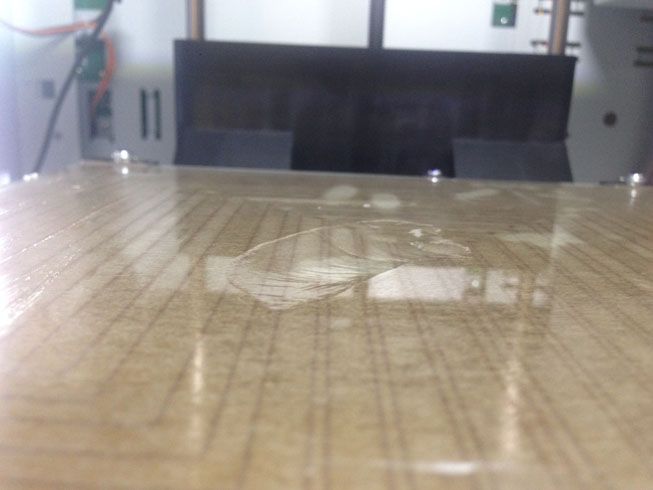
http://i1182.photobucket.com/albums/x459/ShadowWizard1/crack2_zpsfbac4055.jpg
It happened while printing this thing: http://www.thingiverse.com/thing:289497
I placed glue on the bed like normal and went home (My printer is at my store) when i got in, I logged in remotely and sent that to my printer.  Next day when i got to the store the print was not attached to the bed in the slightest; except chip of glass that was no longer part of the rest of the bed.  Yes, that is just a giant chip of glass out of the center of the bed.  I think what was causing it, was the glue was causing it to stick to the bed really well, and the ABS was cooling faster then the glass, causing the ABS to shrink faster then the glass; and because they are stuck together so well.. CRACK!

How I fixed my cracked bed.
So, I contacted XYZ printing.  They want me to send them the old bed, and they will send me a new one when one is available.  Ahh.. no.  I am not waiting forever.  So I decided to try something out.  I had a local glass company cut me a 210mm by 210 mm (Yes, it has to be 210, not 200) square piece of 3 MM glass.  I took off the two strips of metal on either side of the print bed, and laid the glass over top before replacing the two strips of metal.  The screws are long enough they fit just fine.  Then using the thumb screws I lowered the bed down quite a bit then calibrated the bed by eye.

How I calibrated my bed without using the auto useless calibration tool.
To calibrate by eye I basically started a print, and as soon as it actually started extruding turned the printer off.  I then manually positioned the extruder over the glass in each corner and raised the bed.  Because its hard to see exactly where the extruder is, I used the fact the bed has some play in the Z position even when its fixed, and lifted it to see how much space was between the extruder and glass.  Repeated for the other 3 corners, adjusting as needed until I was happy.

Now I am getting error 0010's
I then went back to printing.  I was VERY impressed with the quality of the prints I was receiving from the manual "by eye" calibration I did.  So then i decided to print that same thing AGAIN, but start printing as son as I put the glue down, in case the fact the glue was dry is what caused the bed to crack. (remember, I glued the bed, and went home.)  After a 4:45 print, it took another chunk out of my glass.  The "glass above the glass"  I was very upset, but decided not to dwell on it right then, and started printing other small things.  Error 0010 started popping up often; usually as the bed was raising and heating.  I turn the printer off, and on again, sent the print again, and no problem.  After looking up with 0010 means, it apparently means "Something is wrong with heating someplace." and someone online said it is the error you get when the machine doesn't think the bed is heating up fast enough.  But then I thought "There is an extra piece of glass it needs to heat.. Maybe that's what is causing it.  That would also explain why an off and on would solve the problem without fail, and the error would not come up during prints.  The bed was already partially warm when I did the on and off to clear 0010.  That would explain a lot.  Take longer to heat because of the extra glass, and no errors the second time cause it was already partially heated."

Trying to find an alternative to glue.
So, the next day I decided I was going to switch to using slic3r and the hacked XYZware.  Upped the bed temperature, and the extruder temperature; I decided I was going to play round to find the best heat setting so that I could print stuff, and not have it crack the glass.  I had heard that a higher bed temperature would cause the ABS to adhere to the glass better, so forwent the glue and printed.  I think layer one was set to 115, and each additional was set to 110.  I couldn't get the item off the glass!  I got an exacto knife and tried to pry, and broke the blade.  I got another blade, and started to "saw" it off, to no avail.  At this point I have ANOTHER piece of glass that's useless because it has part of a print attached to it, and the only thing I haven't tried to get it off is fire. (Thank goodness I have many glass bed covers.)  So today I was talking to a friend about the issues I was having.  Turns out he has a friend that does prototypes.  And he recently toured there lab.  They have one of those big monstrous umpteen thousand dollar printers, and a makerbot.  He noticed that on the makerbot bed, they had some kind of felt down or something.  After saying please a few times he emailed his friend.  They use "Build plate tape" http://store.makerbot.com/parts-accesso … tor-2.html  but said it is basically painters tape.

Me experiences with the painters tape solutions (so far)
So of course I ran (Well, drove my motorcycle) as fast as I could to the closest hardware store and got the thickest roll of painters tape they had.  Put some tape down, and started a print.  As soon as the print started it "pulled" at some of the tape.  I then realized, this tape is probably a MM thick, I need to lower the bed a tiny bit more.  So I lowered, re-calibrated, and printed again.  I tried to pull it up with the tape (The print I mean) and the tape just ripped.  Bummer.  So I ripped up all the tape and got my exacto knife and got ready to try and pry this thing off.  I have never had anything come up that easy off that bed.  I was impressed, and quite excited.

Conclusion and summary of suggestions.
So, the moral so far.  As soon as you read this, get a piece of glass (or two) that are 210mm by 210mm cut by your local glass shop, and place that OVER the bed that's already there  That will protect the bed from cracking.  Better to break a $7-$8 piece of glass, then a print bed that will cost you $50+shipping to replace.  I however don't think you will need 3 MM glass, especially if you follow my next recommendation.
Second, and this is still in the testing stage, go and buy a roll of the widest green painters tape you can get.  I spent the money on good tape, and for the $6 for the roll I spent on it, I don't think I will even bother trying cheap "dollar store" tape.  This $6 roll will cover my bed 100X I am sure.  Faster clean up then glue (Any sticky residue I just grab with the tape I already pulled up.) will (hopefully) stop the glass from cracking.  If I am correct about the bed and ABS cooling at different rates, the ABS will simply pull on the tape, that although is stuck to the glass, not stuck so hard it won't just pull off.
Finally, especially when using another piece of glass, error 0010's are (I think) normal.  Just turn off, back on, and resend print.  I have not tried custom firmware yet, but think that will likely solve the problem.
So, I hope this helps some of you out.

55 (edited by jnadke 2015-02-17 23:20:56)

Re: Protecting your bed BEFORE it cracks, and alternatives to glue stick

leenanj wrote:

I think I will try your glue water mix, sound reasonable to me.

How do you apply it, rag, squirt bottle?


jnadke wrote:
darcwarrior wrote:

Two days of printing on the naked bed at 110c with no glue and I just joined the chipped glass club sad Its about 2mm square, off to one side. Looks like i am going back to painters tape.I had left the print overnight, so it was not due to pulling off hot. This stinks,  I just got the bed perfectly level so that i need nothing for the prints to stick. Oh well, lesson learned.
Ouch, that really sucks.  I feel for ya man.

I hate the glue stick because it always comes off clumpy and doesn't provide a level surface.


As I mentioned in a different thread, I like mixing Elmer's Glue All with Water (1 part glue to 8-10 parts water).  I then smear it on for a "frosted glass" look.  The water evaporates as the bed heats up.

It creates a good breakaway layer, and provides excellent adhesion.  Sometimes the glue comes up on the bottom of the print, but better the glue than the glass!


I hate tape, because it has a significant thickness and requires re-calibrating the bed height.

I shake it up in a travel shampoo bottle (or similar bottle, hand sanitizer, etc... just get all the gunk out).


I squirt a few dime-size drops on the print bed (about 5), and take a piece of folded paper towel and smear it thin.  I generally don't do swirling motions, just front-to-back.

For the first application I do it 2 times.  Heat the bed up to 55 degrees and the water will evaporate within 30 seconds.  It will look like frosted glass.

In between prints I just leave the old stuff on there and throw on one more coat.  I haven't gotten to the point of needing to take the old stuff off yet... I hear rubbing alcohol works, I'll try that tonight and post results.  Otherwise water and a flat razor blade should work.


Your prints will not come off at all until they have fully cooled.  You will hear some popping sounds as it comes off the glue surface.  But I've been running this for 100+ hours and haven't cracked my bed yet.

The Elmer's Glue All might be overkill (you can get it at Target, Office Depot, Staples, or a Crafts Store), you could try just standard Washable stuff.  I at times get too much adhesion with the Glue All.  But as I said, it will come off before the glass cracks.  Some of my prints have a little glue on the bottom of them.  Usually I'll find the corner of my print that has popped off due to shrinking and wedge the scraper in there.  The rest of the print pops off in short order.  If it's big enough, I'll just grab the entire print and twist it in a twisting motion, that'll usually pop it off too.

56

Re: Protecting your bed BEFORE it cracks, and alternatives to glue stick

You could just use elmers brand glue stick. It does not clump at all. Just spreads a thin coat evenly and it is good for several prints. Cleana up with just water. They make a purple version as well that dries clear but is a bit harder to clean up.

Printing since 2009 and still love it!
Anycubic 4MAX best $225 ever invested.
Voxelabs Proxima SLA. 6 inch 2k Mono LCD.
Anycubic Predator, massive Delta machine. 450 x 370 print envelope.

57 (edited by jnadke 2015-02-18 02:34:38)

Re: Protecting your bed BEFORE it cracks, and alternatives to glue stick

carl_m1968 wrote:

You could just use elmers brand glue stick. It does not clump at all. Just spreads a thin coat evenly and it is good for several prints. Cleana up with just water. They make a purple version as well that dries clear but is a bit harder to clean up.

Yeah, I tried that, it's never even and the print head drags in it.

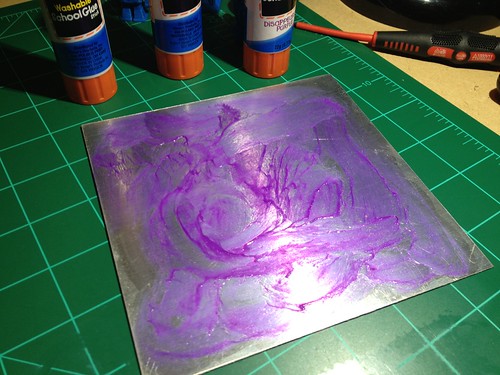
Always ends up looking similar to this (NOT MY PICTURE):
http://farm4.staticflickr.com/3715/9459875293_e1f4e3229c.jpg


The glue-dissolved-in-water is the best way to get a nice, even, thin coating.

Some use the Elmer's Washable Glue, I've seen Elmer's Wood Glue used, I used Elmer's Glue All and got tons of adhesion, might try the Washable Glue.

It ends up looking like this:
http://i.imgur.com/BDmlc1r.jpg

58

Re: Protecting your bed BEFORE it cracks, and alternatives to glue stick

Read all comments here. Everyone has the only slightly uninque technique. I still think in my case if I can heat up the bed a little then I will be able to get the prints off. It feel really stuck on the bed. I used Blue tape then glue. After my other notes i think why the XYZware Open Mod version does not work on my PC is because i upgraded the Firmware bummer.

59

Re: Protecting your bed BEFORE it cracks, and alternatives to glue stick

Read all comments here. Everyone has the only slightly uninque technique. I still think in my case if I can heat up the bed a little then I will be able to get the prints off. It feel really stuck on the bed. I used Blue tape then glue. After my other notes i think why the XYZware Open Mod version does not work on my PC is because i upgraded the Firmware bummer.

60

Re: Protecting your bed BEFORE it cracks, and alternatives to glue stick

I run my bed at 100C with a cheap glue stick application and cover all my vents so the cabinet temp stays pretty warm.. Almost no warp aged. I read all the comments and each time I came across one where someone leaves their printer to print un-attended, I automatically think of a fire hazard waiting to happen.  Please take the minimal steps to remove anything close that would catch fire if your printer was to malfunction after all, it is only another machine that has a heat source... even the steppers get hot.. Happy printing..

61

Re: Protecting your bed BEFORE it cracks, and alternatives to glue stick

I have had the same issues with all of my 3D Printers, and found that if you apply 2 coats of glue stick on the print bed while it is at room temperature, and then letting it dry completely before printing, your bed wont crack, and you don't have to really apply glue again for a wile.

Happy printing!

62

Re: Protecting your bed BEFORE it cracks, and alternatives to glue stick

Hi! My first post here. About protecting the bed with extra piece of glass... what about using thin sheet of anodized aluminium (0.5-0.7 mm) "glued" on top of original bed with thermal paste? This could heat up properly and never crack. Upcoming Pro model of Da Vinci has aluminium print bed.

63

Re: Protecting your bed BEFORE it cracks, and alternatives to glue stick

opeekoo wrote:

Hi! My first post here. About protecting the bed with extra piece of glass... what about using thin sheet of anodized aluminium (0.5-0.7 mm) "glued" on top of original bed with thermal paste? This could heat up properly and never crack. Upcoming Pro model of Da Vinci has aluminium print bed.

Yes it has an aluminum bed. But you cant print directly to it unless it is specially treated. The intended use of an aluminum bed is to put Kapton tape over it if using iy heated, and blue painters tape if cold for PLA.

I had a 3Dstuffmaker Evolution and it had an aluminum bed that was meant to be printed directly on. It had a very smooth like glass flat finish to it, it was not just aluminum plate you csn buy as raw materials.

Printing since 2009 and still love it!
Anycubic 4MAX best $225 ever invested.
Voxelabs Proxima SLA. 6 inch 2k Mono LCD.
Anycubic Predator, massive Delta machine. 450 x 370 print envelope.

64

Re: Protecting your bed BEFORE it cracks, and alternatives to glue stick

Hi, my bed is cracked and was looking for a fast temporary fix while a new one is coming in. Should I use masking tape and if I do,  does that prevent me from using the auto leveling feature that is built in to the printer.

Background: I have had my da Vinci 1.1 Plus for a week now and have been printing non stop, using glue.

65 (edited by scobo 2016-04-08 16:37:02)

Re: Protecting your bed BEFORE it cracks, and alternatives to glue stick

There is another option, an acrylic plate.
I've been using one on top of my glass bed for a couple of months now.
It has the advantage of being removeable so you can coat it with hairspray away from the printer.

Davinci 1.0 with repetier firmware & E3D V6 Lite
Anycubic Photon DLP printer, Einscan-S 3D scanner
Simplify3d, 123D Design, Meshmixer
http://www.thingiverse.com/scobo/designs

66

Re: Protecting your bed BEFORE it cracks, and alternatives to glue stick

I guess what I'm trying to say is that if I put tape over the crack would that effect the way it auto levels/calibrate. Masking tape is roughly 0.1mm and I was wondering if that was enough to effect the first layer of a print. attached is a picture of the cracked bed. http://soliforum.com/i/?jdOASJM.jpg

67

Re: Protecting your bed BEFORE it cracks, and alternatives to glue stick

You want to forget about auto calibration for starters. See the sticky on the first page of the forum about manual levelling.
You would then just adjust your bed hight slightly to allow for the masking tape if need be.

Davinci 1.0 with repetier firmware & E3D V6 Lite
Anycubic Photon DLP printer, Einscan-S 3D scanner
Simplify3d, 123D Design, Meshmixer
http://www.thingiverse.com/scobo/designs

68

Re: Protecting your bed BEFORE it cracks, and alternatives to glue stick

I have never printed directly on my heated glass bed since I broke it the first time.  I buy the $13USD borosilicate glass sheets off Amaxon, and screw them on on top of the heated glass. 

They chip monthly, so I just turn the glass over.  I get 2 months or so out of each piece, and the bed is still pristine!

Da Vinci 1.0a.  Repetier 0.92.  E3D V6.  Titan Extruder.  Sllic3r.  Octoprint on Raspberry Pi B+.

69

Re: Protecting your bed BEFORE it cracks, and alternatives to glue stick

I have been running 3 Da Vinci 1.0's on end to end jobs for nearly 3 months and this hasn't been an issue? 

I use UHU glue sticks and slic3r to produce the G code.  Most jobs run overnight / during the day, when I retrieve the jobs most are stone cold and have come loose from the print bed.  Note that I make a point of cleaning the glue off not very well and I lay it on very thick.

70

Re: Protecting your bed BEFORE it cracks, and alternatives to glue stick

maybe its a symptom of aquanet hair spray...  That stuff really sticks!

Its so much easier to apply than glue sticks, I'll sacrifice some glass for the ease.

I just spray the hairspray on a foam brush and run a light coat over the bed.

Da Vinci 1.0a.  Repetier 0.92.  E3D V6.  Titan Extruder.  Sllic3r.  Octoprint on Raspberry Pi B+.

71

Re: Protecting your bed BEFORE it cracks, and alternatives to glue stick

Since I had my first glass chiped off I use a thin film af ABS-juice when printing bigger parts - never had any issue again!

72

Re: Protecting your bed BEFORE it cracks, and alternatives to glue stick

crackhttp://soliforum.com/i/?NWsKsQg.jpg

Sd4 #9080 with a glass bed. E3d chimera duel extruder. Paste extruder , duet wifi.
Lawsy carriages. linear bearings. Y axis direct drive, Kinect scanner
SD4#8188 glass bed, lawsly carriages, E3d v6, octoprint http://www.ustream.tv/channel/hotrod96z28
Filastruder/filawinder, Custom Delta 300mm x 600mm

73

Re: Protecting your bed BEFORE it cracks, and alternatives to glue stick

I use glue stick, have never broke any glass.. The trick is to let it cool off completely,, it usually pops off by itself.

74

Re: Protecting your bed BEFORE it cracks, and alternatives to glue stick

I replace mine with this one: https://shop.stoutwind.de/Floatglasplat … r-Da-Vinci

From now on I always use ABS-juice to protect the glas!