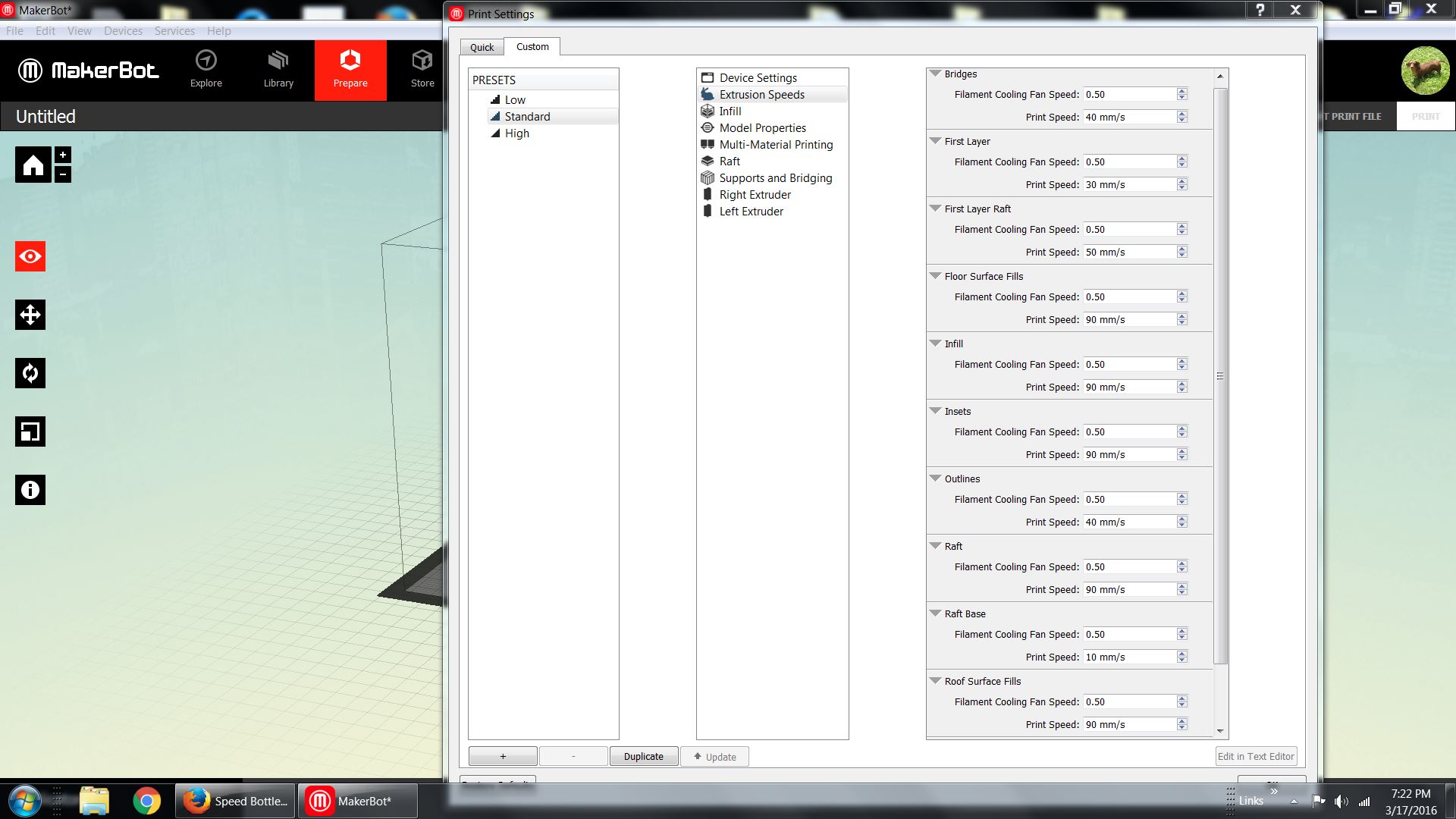
There are a few factors that are going to affect the print speed,
The first is desired accuracy. No mater what printer the faster you print the less accuracy you will have. This can to some degree be over come by the design of the machine and what hardware you have.
Cartesian machines are simpler to set up and generally will have very easily and reproducible accuracy but will be slower then delta machines.
Delta machines are generally faster but are more complex and have more sources for introducing inaccuracies.
core xy machines are a hybrid between the delta and Cartesian machines so are in general more accurate then the delta machines while being slightly slower however they are generally faster then Cartesian machines but are also less accurate
The type of drive will also affect speed. Bowden can usually be faster since you have less mass. this makes it so you don't need as powerful motors, you usually have less acceleration and deceleration issues, and usually less harmonics. However you also have more of a limitation on what materials you can print and the some slippage in the press fit connections which affects the accuracy of the extrusion.
Direct drive has less material restrictions (for a well built extruder) is more accurate in extrusions and retractions but has more mass so you have issues with acceleration and deceleration which usually means you have more harmonics.
Note as you ramp up speed with stepper motors you run into a greater chance of missed steps due to inertia of the hardware and the stepper motors being unable to produce the needed torque. the torque also drops off the faster you move so at top speed you have 70% of the rated torque. so you can use more expensive motors that have more torque but realize this also requires a stepper motor and stepper driver that can handle the increased power requirements.
So speed will really be about the same in most cases since they hardware used is generally speaking nearly the same.
Some of the higher end machines are more expensive due to tighter tolerances and better/stronger hardware and that can affect your top speed.
So if you have better liner motion tolerances from linear rails and trucks, these being better then case hardened rods and linear bearings which are again better then rods and bronze bushings you can go faster due to better rigidity.
Next your looking at the motors these can be stronger motors or even more accurate motors (.9 deg per step vs 1.8 deg per step stepper motors) and better stepper drivers . Most printers use stepper drivers that can give 16 microsteps but there are ones that can support 32, 128, or 256. Some of your high end drivers can support up to 5 or more amps which allows for more powerful stepper motors. Most hobby level stepper drivers can support 1.5 to 2 amp
Another thing to look at is the extruders a better extruder design will allow for faster prints as well
Also a lot of high speed printers are using larger nozzles say .6 .8 or even 1 mm. however this does give you less accuracy
Again it always comes down to accuracy vs time more accuracy is all ways going to take longer but hardware and software can and do make a difference as well
I have seen a video where some one tune their davinci up just right to print at 90mms but he has to keep up on the maintenance and make sure everything is just right. he does not recommend that setting for most people he has it set as a top speed for most people at 70 mms and I think that is a bit ambitions in general for these machines
With a stock davinci I don't think you will get good results above 60mms without some work.
Any way that's my take on it.